Why Parents Lead: Voices from the Field
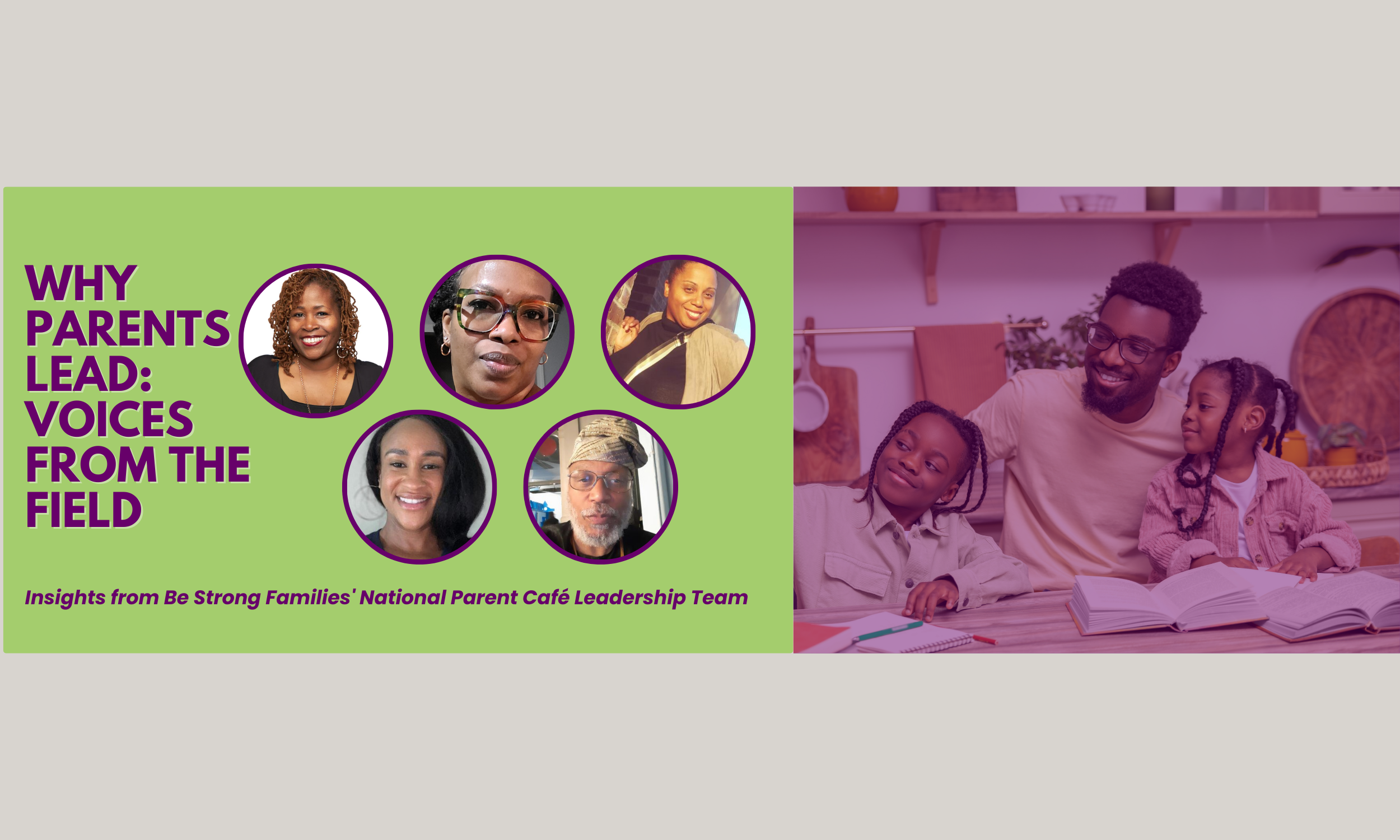
Insights from Be Strong Families' National Parent Café Leadership Team
Ask most parent leaders how they got started, and you’ll hear a familiar theme: someone saw something in them that they hadn’t yet seen in themselves.
A colleague. A program coordinator. Someone who said, simply — you should be here.
That moment of being seen, and then choosing to show up for others, sits at the heart of Be Strong Families’ National Parent Café Leadership Team. The team is made up of parents from across the country who do far more than attend Parent Cafés. They host them, shape them, review curriculum, serve on the board, and act as ambassadors for a belief that continues to prove itself true: everything is better when a parent voice is in the room.
While each parent’s journey into leadership differs, they share something unmistakable — the experience of being invited into something larger than themselves.
Getting Started: The Nudge That Changes Everything
For many parent leaders, the path into leadership doesn’t begin with a plan. It begins with a nudge.
Anneasyka Roston, a Kansas City native involved in parent leadership since 2012, describes her entry point with humor and honesty. “It wasn’t a volunteer situation — I was literally volun-told,” she explains. When a YMCA staff member namde Randa asked her to attend a meeting.
She went in not fully convinced, not entirely certain, and left with a new sense of purpose. “You want to know what I think? You want to hear my ideas?” she recalled thinking. That simple shift, recognizing that her voice held value, marked the beginning.
Andreé Long’s story unfolded in a very different emotional landscape. She was scheduled to attend a Be Strong Families training when she lost her father. In the midst of grief, she found unexpected support from people who, as she put it, “didn’t know me from Adam.” Being held by a community of strangers changed her understanding of what these spaces could offer—and what she had to offer to her community. “I want to be that person to stand in the gap,” she said.
For Onaje Muid, a fatherhood coordinator in Delaware County, Pennsylvania, parent leadership aligned with a lifelong commitment to healing historical trauma. Finding Be Strong Families felt less like discovery and more like recognition, “the best thing since peanut butter and jelly.”
Different stories. Different starting points. The same underlying theme: someone opened a door.
What Keeps Parent Leaders Coming Back
Parent leadership is rarely fully compensated work—and yet leaders return, year after year. Not out of obligation, but because of what they witness.
For Tykayla Taylor, a mom of four and parent ambassador for the Kane County Health Department, the motivation lives in real time moments of transformation. She describes Cafés where participants move from quiet observation to emotional release, “those moments where they’re crying… and they’re saying, ‘I wouldn’t have known — I would have been down if I never stepped in.’”
Anneasyka speaks about impact with similar clarity. “The impact is so great that I would do it for free,” she says, explaining how watching parents move from isolation to connection sustains her. “A lot of times going through your parenting life you feel like you’re the only one… When you come into these spaces, you find out: oh, I’m not alone.”
For Onaje, that motivation carries into his weekly fatherhood program at a correctional facility — moments when individuals reconnect with truths long buried. “Those are the moments I live for.”
Across experiences, one thread runs consistently: parent leadership is fueled by lived, witnessed change.
Equity Isn’t Just a Value — It’s the Work
When the conversation turns to equity, the reflections become even more personal.
Tykayla shares how her own learning differences once made her question whether she could fully contribute. What changed her trajectory was not accommodation alone, but affirmation — hearing teammates say, “we still need you.” That experience reshaped how she now engages others. “Everybody matters. Everybody has a purpose in some kind of way.”
Anneasyka frames equity as something both simple and radical. “When you know that you are valued — that what you’re saying is considered, even if they don’t use your idea — that’s so important.” In many systems, she notes, parents rarely receive that message.
Onaje widens the lens, connecting personal experience to structural realities — maternal mortality rates among Black women, policy legacies, and the persistence of manufactured inequality. “If we’re not understanding how oppression is a part of our work,” he explains, “we can never really get to those levels of power that are going to reverse the conditions of oppression.”
Equity, in this context, is not an add-on value. It is foundational to meaningful engagement.
From Participant to Leader: A Gradual, Intentional Process
Parent leadership doesn’t happen by declaration. It happens through design.
The Be Strong Families model is intentionally incremental. Parents begin as table hosts, build comfort, co-host Cafés alongside staff, and gradually assume greater responsibility. Over time, professionals step back — not abruptly, but intentionally.
Because, as Sarita Sashington puts it, “If you can do it, the parent can do it.”
Often, the barrier is not parental readiness, but professional hesitation — the instinct to hold on rather than release. Leadership transfer, at its core, is an act of trust.
What Organizations Can Do Differently
The lessons emerging from parent leaders are practical, and deeply relational.
Rapport matters. Anneasyka was “volun-told” because someone took the time to build even a small connection. Tykayla emphasizes the importance of keeping outreach personal — real texts, real conversations, real humans. “It cannot get stagnant,” she says. “You have to keep that environment where there’s still a hug in it.”
Accessibility matters too — language, ease of sign-up, meaningful feedback loops. And perhaps most critically, parents need to know they are not merely welcomed. They are needed.
The Bottom Line
Parent leadership isn’t an enhancement to Be Strong Families’ model. It is the architecture.
Parents review curriculum, sit on the board, host Cafés, and shape the work from the inside. They are, as Sarita notes, the ones who have “the goods.”
Parent leaders are not born fully formed. They are invited, supported, nudged, and trusted.
And when a parent walks into a room and realizes their voice matters?
They don’t just stay.
They bring others with them.
This article is based on a Be Strong Families webinar, "The Parent Influence: Why We Become Parent Leaders," featuring National Parent Café Leadership Team members Andreé Long, Tykayla Taylor, Onaje Muid, and Anneasyka Roston, hosted by Sarita Sashington.